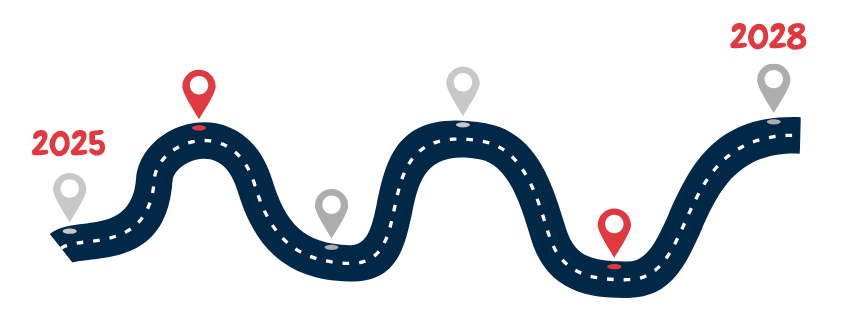

NAPAHE's 2025-2028 Strategic Plan
NAPAHE is pleased to announce the details of the association's 2025-2028 Strategic Plan, a member-driven roadmap that outlines how we will strengthen the value of your membership, expand opportunities for connection, and ensure our long-term stability as an association. This plan is focused on what matters most to you and your work.
Higher education continues to grow more complex, and the demands placed on professionals supporting senior leaders have never been greater. Over the past year, we listened closely to your feedback through surveys, conversations, and engagement across committees. Members asked for more relevant development, a stronger community, and a clearer sense of membership value.
This multi-year strategic plan is our response. It ensures that NAPAHE remains aligned with your needs today, and well‑positioned to support you in the years ahead.
Overview of NAPAHE's Four Goals for 2025-2028
Goal 1
The first goal focuses on strengthening professional development. Our aim is to build programming that is more tailored to your role, your functional area, and your career stage. We’ll be using research, member input, and a comprehensive needs assessment to shape new content pathways.
We’re also expanding leadership opportunities within affinity groups and creating more ways for you to connect locally and nationally.
Ultimately, this goal is about making sure that NAPAHE supports your growth, not just at the conference, but throughout the year.
Goal 2

Our annual conference is one of the most important points of connection for our members, and this plan invests in making it even more impactful. We’re enhancing the way we evaluate conference content and aligning sessions more closely with member needs and industry trends.
You’ll see more interactive formats, more opportunities to learn from colleagues, and new member‑only experiences that deepen your connection to the community. We are also expanding the programming that surrounds the conference to provide year‑round value.
Goal 3

The third goal focuses on expanding and diversifying our membership.
As we grow, your network becomes richer with more voices, more institutional perspectives, and more opportunities for collaboration. We’re enhancing our value proposition, strengthening our communications, and improving onboarding to ensure new members feel welcomed and supported. We’re also building partnerships and expanding outreach to institutions and roles that have not historically been represented at NAPAHE.
Goal 4

The fourth goal is about strengthening NAPAHE’s foundation so that we can continue delivering high‑value programs and services for years to come.
This includes updates to our bylaws, committee structures, leadership pathways, and budgeting practices.
It ensures that our governance reflects best practices and that we are resourced appropriately to support the work ahead.
Plan Methodology
NAPAHE's Strategic Plan was developed in two phases led by the organization's Board of Directors and supported by the Executive Director. The first phase was a comprehensive business analysis, which included a market assessment, a member survey, and a variety of internal workshops facilitated by an external consultant, Essentiam. The second phase focused on planning, including an organizational assessment, virtual and in-person visioning workshops, and implementation planning.
The 2025-2028 Strategic Plan is organized into three descending tiers.
- Goals are broad general statements of longer-term desired outcomes.
- Objectives are statements of shorter-term specific outcomes, measurable in quantity and time, that advance achievement of an associated goal.
- Tactics are specific actions to be performed by responsible parties to carry out an associated objective.
Goal 1: Deliver intentional, member-driven professional development that elevates our members’ knowledge and expertise, recognizes diverse career paths, strengthens affinity groups, and fosters continuous growth.
Objective 1.1: Fully assess and define the range of professional development needs of our current and potential membership through a comprehensive research process.
Objective 1.2: Develop a gap analysis of our existing professional development content based on the research from 1.1
Objective 1.3: Create a multi-year plan for enhancing our offerings based on the findings from 1.1 and 1.2
Objective 1.4: Strengthen affinity groups by establishing leadership structures, expanding opportunities for connection, and developing specialized content relevant to their roles.
Goal 2: Produce a nationally recognized, independent annual conference that delivers relevant programming, fosters meaningful connections, and catalyzes member engagement.
Objective 2.1: Profitably deliver our first independent annual conference in 2026 while maintaining or improving attendee satisfaction scores.
Objective 2.2: Establish a process and quantifiable annual goal to ensure conference programs consistently focus on current industry trends and emerging technologies.
Objective 2.3: Determine signature on-site elements (environments and activities) that promote dialogue and collaboration to enable conference attendees to make meaningful connections.
Objective 2.4: Increase the number of members attending the conference year-over-year throughout the strategic plan period.
Objective 2.5: Establish the annual conference as a driving force in member connection to NAPAHE.
Goal 3: Grow and sustain a diverse national membership by promoting NAPAHE’s value and deepening and broadening our institutional reach.
Objective 3.1: Develop and implement a marketing strategy to promote our value to potential members and key influencers.
Objective 3.2: Expand our reach within the institutions of current members to appropriately include more functional area representatives.
Objective 3.3: Increase and diversify the number of institutions represented by NAPAHE members to include a wider variety of institutional types and more diverse regional representation.
Objective 3.4: Understand what is driving retention and use it to inform our programmatic and engagement efforts with potential new members.
Objective 3.5: Implement an annual member survey that goes beyond demographics to better understand engagement and value of NAPAHE and its programs.
Goal 4: Strengthen NAPAHE’s organizational foundation through strong governance, clear leadership pathways, and resources aligned to support scalable growth and long-term stability.
Objective 4.1: Review and revise our bylaws to ensure appropriate member categories, committee structure, annual meeting timing, and officer terms.
Objective 4.2: Establish processes for reviewing and updating committee charters on a regular basis and encouraging engagement of additional volunteers.
Objective 4.3: Establish leadership succession plans (board and staff) and a pipeline and development process for new board candidates.
Objective 4.4: Implement a skills matrix process as part of board nominations to ensure intentional recruitment of folks with the necessary skills and attributes to enable NAPAHE’s strategic direction.
Objective 4.5: Develop a budgeting practice that designates appropriate resources, including staff, systems, and other expenses through a balanced annual budget.
NAPAHE Mission Statement
NAPAHE strengthens the professions of its members through programming, networking, and professional development opportunities that address the broad range of roles fulfilled by professionals who support higher education’s senior leaders.
NAPAHE Vision Statement
To be the association of choice for professionals who support leaders in higher education.